
Wildfire Resilience Project Summary
Allyn Feinberg • October 21, 2026
Wildfire Resilience Overview
Overview
- Date/Event: October 22, 2026 City Council Study Session.
- Title: Enhancing Boulder’s Wildfire Resilience through the Development of a Home Hardening Implementation Hub and Assessment of Current/Planned Programs.
- Context: This memo presents the final work for the 2026 Wildfire Resilience Council Priority, transitioning from framework development to focused implementation ("Wildfire Ready 2030").
- Document Link: 10/22/2026 Packet
Core Framework
Wildfire Ready 2030 Staff propose a comprehensive framework to guide wildfire resilience efforts through 2030, organized around four strategies:
- Fire Adapted Communities: Inspire homeowner action on hardening and defensible space via incentives and insurance alignment.
- Resilient Landscapes: Reduce fuels on public/private lands (WUI).
- Safe and Effective Wildfire Response: Strengthen evacuation, response, and ignition prevention to protect life safety.
- Responsible Governance: Coordinate departments, diversify funding, track progress, and communicate results.
Key Components & Metrics
- Inventory: Framework includes 137 projects across 25 programs, with 10 Tier 1 priority programs identified for immediate implementation (e.g., Wildfire Risk Reduction, Fuels Management, Evacuation Planning).
- Geographic Prioritization: A Wildland Urban Interface (WUI) Risk Index divides Boulder's western WUI into 12 sections rated as Highest, Very High, or High risk to guide investment.
- Performance Measures: Staff developed 14 measures with targets for the end of 2030, covering fuel loads, home hardening rates, evacuation times, and suppression success (e.g., "55% of homes in priority sections receive Detailed Home Assessment").
- Tracking: Annual progress reporting is anticipated to utilize an adaptive management approach.
Financials & Enhancements
- Current Investment: Approximately $10–11 million annually across ten city departments (existing baseline).
- 2027 Priority Enhancements: Staff identified four areas requiring additional investment for meaningful impact: Home Risk Reduction, Community Preparedness, Fuels Management in WUI, and Tactical Evacuation.
- Need: Up to ~$1.85M in 2027 enhancements.
- Funding Sources: Realigning Climate Tax Funds ($1.8M), Open Space Fund (up to $600k), and external grants (Federal, State, County; including potential $10M Community Wildfire Defense Grant).
- Long-Term Financing: Staff will evaluate alternative financing mechanisms (e.g., property-based financing, bonds) to sustain long-term resilience beyond annual operating budgets.
Home Hardening Implementation Hub
- A centralized, accessible web resource designed to help residents translate preparedness information into mitigation action.
- Features instructional videos, project prioritization tools, cost information, and insurance guidance.
- Targets all residents (owners/renters) regardless of whether they have completed a home assessment.
Equity & Climate Considerations
- Equity: Highest risk is in the western WUI; hardening these areas protects everyone citywide. Vulnerable populations outside the WUI benefit indirectly from reduced fire spread risk. The Hub includes multi-modal resources for varying budgets and languages.
- Climate/Sustainability: Programs balance community safety with ecosystem health (e.g., grazing, prescribed burning) to address interlinked hazards like drought and flash flooding.
Strategy Details
Fire Adapted Communities Program
FAC1: Wildfire Risk Reduction for Homes & Property
- Desired Outcomes: Reduce ignition likelihood, increase survivability, reduce structure-to-structure spread, and increase insurability.
- Scope: Includes IR1 (first row), IR2 (second row), and IR3 (interior) homes adjacent to WUI natural areas. ~2,000 parcels in 12 priority sections; ~10,000 across the broader WUI.
- Aspiration: 100% of homes in WUI zones eligible for "Wildfire Prepared Home Essential" designation (an insurance-recognized standard valid for three years).
- Key Targets by 2030:
- Measure 1: 55% of homes in the 12 priority sections receive a Detailed Home Assessment (DHA) to qualify for WRAP grants (~400 DHAs completed annually).
- Measure 2: 20% of homes in the 12 priority sections hardened to eligible standards.
- Strategy: Engages homeowners through communication, risk understanding, and resourcing (grants/staffing). The plan notes that a regulatory trigger may be needed beyond voluntary models to reach 100%.
- Current Annual Cost: $1.0M to $1.5M
FAC2: Wildfire Resilient Building & Landscaping Standards
- Goal: Track wildfire-resilient construction activity in high-risk areas.
- Scope: New construction and significant remodels in IR1/IR2 zones.
- Measure 3: Monitor the number of building permits issued annually that comply with International Wildland Urban Interface Code requirements.
- Compliance is confirmed via a "Letter of Completion" issued by City staff.
- Permit volume fluctuates based on market conditions and weather events prompting repairs.
- Current Annual Cost: $0.5M to $1.0M
FAC3: Community Emergency Preparedness
- Desired Outcomes: Educate residents on evacuation to save lives; strengthen neighbor-to-neighbor networks for vulnerable residents.
- Aspiration: Reach 100% of homes across all 12 WUI priority sections with evacuation programming by 2030.
- Measure 4: 75% of homes in the priority sections receive evacuation programming by 2030.
- Programming includes route planning, grab list creation, and understanding emergency alert levels.
- Strategy: Requires dedicated outreach staff, translated materials, sustained neighborhood presence, and partnerships to reach renters and non-English speakers.
- Current Annual Cost: $0.25M to $0.5M
Resilient Landscapes Program
RL1: Wildfire Fuels Management in the WUI
- Goal: Treat vegetation to keep fire manageable and protect the built environment. Work is ongoing after initial treatment for monitoring and reentry.
- Aspiration: 100% of WUI natural areas (regardless of ownership) treated to prescription.
- Measure 5 Target: 100% of city-owned acres in WUI natural areas across all 12 priority sections will be treated by the end of 2030.
- Private Land Strategy: Requires cross-boundary partnerships, landowner agreements, and county/state/federal grants to manage private holdings (~30% of total acreage).
- Current Annual Cost: $1.5M to $2.0M
RL2: Wildfire Fuel Breaks
- Goal: Create landscape-scale fuel breaks west of the 1,500-foot WUI zone to intercept fire from the west before it reaches communities.
- Aspiration: 100% of modeled wildfire approach pathways encounter a treated fuel break.
- Measure 6 Target: 70% of modeled "wildfire approach pathways" from the west will encounter one or more landscape-scale fuel breaks in treated condition by the end of 2030.
- Requirements: Needs land access agreements, sustained funding, and expanded contractor capacity. A network map must be completed to estimate resource requirements.
- Current Annual Cost: $0.5M to $1.0M
RL3: Prescribed Fire Program
- Goal: Reintroduce fire as a natural tool to reduce fuel loads within historic return intervals (5–15 years).
- Aspiration: 100% of lands in range of historic variability.
- Measure 7 Target (Burn Planning): 50% of city-owned land in priority WUI sections covered by a current burn plan by end of 2030.
- Measure 8 Target (Burn Performance): 50% of available "burn days" will be utilized through end of 2030.
- Requirements: State-level regulatory flexibility, expanded crew capacity, interagency associations, and community smoke tolerance engagement.
- Current Annual Cost: $0.25M to $0.5M
Desired Outcomes (Across all programs)
- Lower flame lengths and keep fire on the ground.
- Slow the rate of wildfire spread.
- Reduce burn severity and post-fire erosion impacts.
- Maintain or improve ecosystem health.
- Provide response crews more time and access before fire reaches structures.
Safe and Effective Wildfire Response Program
WR1: Effective Wildfire Response
- Measure 9: Prevent wildfires from reaching the built environment by keeping them in the wildland.
- Target: 90% of recorded wildland ignitions on city-managed and adjacent lands will be contained at or under 1 acre through 2030.
- Note: This target applies to typical conditions (not extreme weather). The document notes an aspiration where 99% might be achieved with additional capacity.
- Definition: "Wildland ignition" refers to fires originating in vegetation outside the built environment within or adjacent to Boulder's WUI.
- Current Annual Cost: $1.5M to $2.0M
WR2: Tactical Evacuation
This program distinguishes between planning and performance validation.
- Measure 10 (Evacuation Planning): By the end of 2028, 100% of city evacuation polygons will feature current RSET assessments and complete polygon attribute documentation.
- Timeline: Remaining polygons are scheduled for updated assessments by the end of 2027; mock evacuations in high-risk neighborhoods validate clearance times.
- Measure 11 (Evacuation Performance): The Average Required Safe Evacuation Time (RSET) will be 2.5 hours for the 12 WUI priority sections, maintained through 2030.
- Definition: RSET is calculated using traffic modeling and accounts for detection, alerts, milling time (time to move toward exit), and drive time to safety.
- Current Annual Cost: $0.05M to $0.25M
WR3: Ignition Prevention & Utility Hardening
- Measure 12 (Ignitions): Aiming for a 10% reduction in the five-year rolling average of human-likely wildfire ignitions compared to the 2021–2025 baseline by the end of 2030.
- Baseline: Approximately 43 human-likely ignitions per year (based on city responses).
- Measure 13 (Utility Hardening): Undergrounding 20 miles of overhead utility lines in and around Boulder by the end of 2030, coordinated with Xcel and PUC.
- Goal: Reduce human-caused and electrical utility-caused ignitions to zero eventually.
- Current Annual Cost: $0.5M to $1.0M
Responsible Governance Program
RG1: Wildfire Communications & Engagement
Primary Goals & Outcomes
- Community Awareness: Increase understanding of wildfire risk, home hardening, and risk reduction.
- Action Motivation: Help residents feel informed to complete preparedness actions (e.g., defensible space).
- Resource Connection: Link community members with Wildfire Ready resources.
- Trust Building: Establish public trust in the city’s wildfire resilience work.
Measurement & Targets (Measure 14)
- Metric: A multi-question survey instrument tracks self-reported contributions rather than claiming City communications solely caused actions.
- Target: By the end of 2030, 55% of surveyed residents engaged in wildfire preparedness should report that City information made them more likely or better informed to take mitigation/risk-reduction action.
- Focus: There is a specific emphasis on increased participation among residents in priority wildfire-risk areas.
- Current Annual Cost: $0.25M to $0.5M
Methodology & Engagement Channels
- Touchpoints: Interactions include the Wildfire Ready Hub, webpages, newsletters, social media, community events, preparedness walks, home assessments (WRAP), presentations, and direct staff engagement.
- Evaluation Results: Data will be assessed over time and segmented by geography/risk area to identify gaps in reach and effectiveness.
- Aspiration: To ensure residents consistently receive, understand, and use wildfire information, supported by sustained, repeated engagement across multiple channels.

PLAN-Boulder Country 2026 Candidate Endorsements
PLAN-Boulder County 2026 Ballot Issue Endorsements
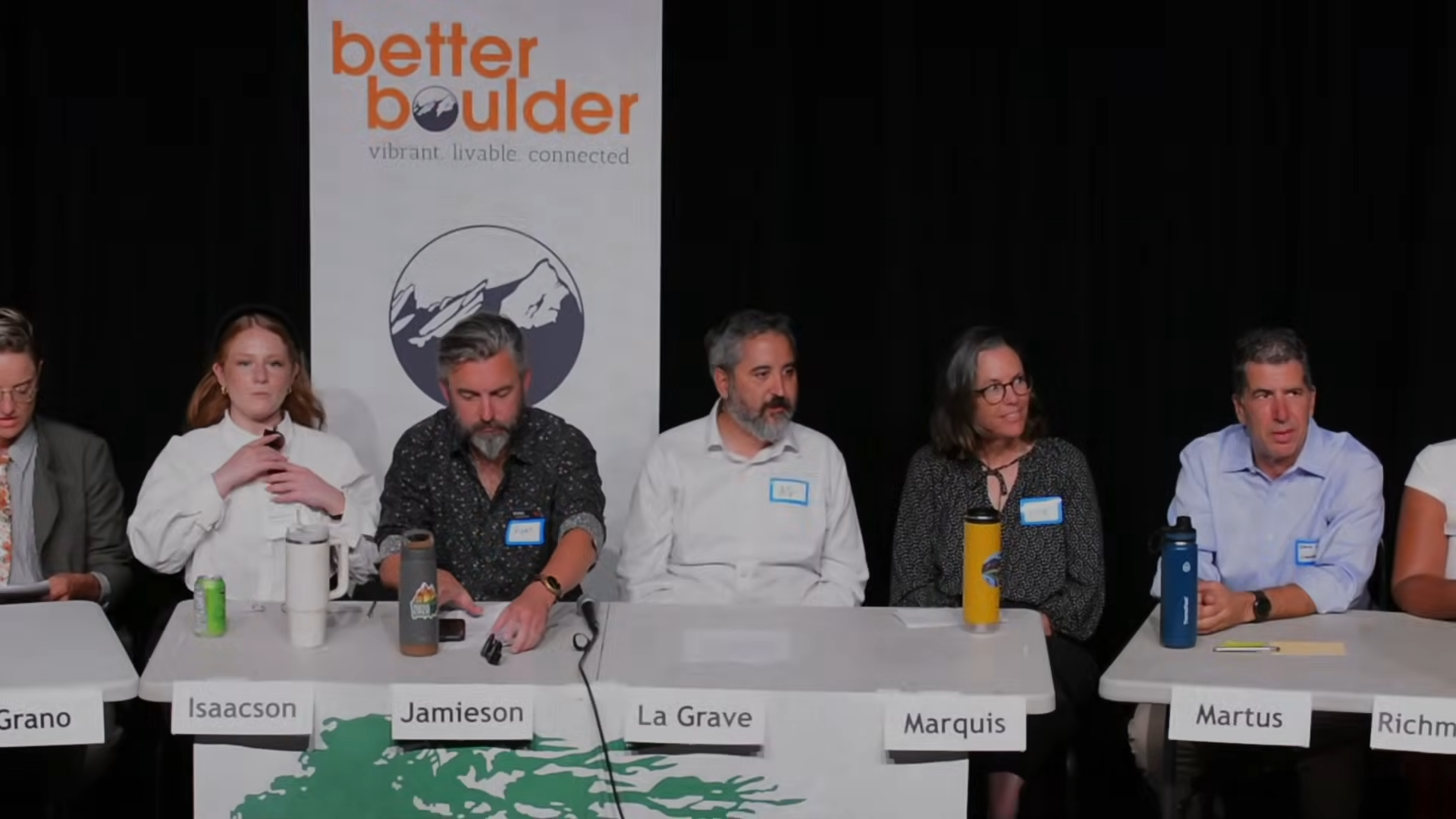
Watch the video recording of the Sept. 2, 2026 Forum to get to know who is running for Mayor and the 5 open City Council seats .

Several projects in the works deserve a closer look.
2026 is a watershed moment for Boulder's budget.

Since the pandemic staffing levels have risen significantly.

Boulder sales tax revenue is flat and is anticipated to decline in coming years.
The 2026 Budget is set to levy a new fee on all property in Boulder.
